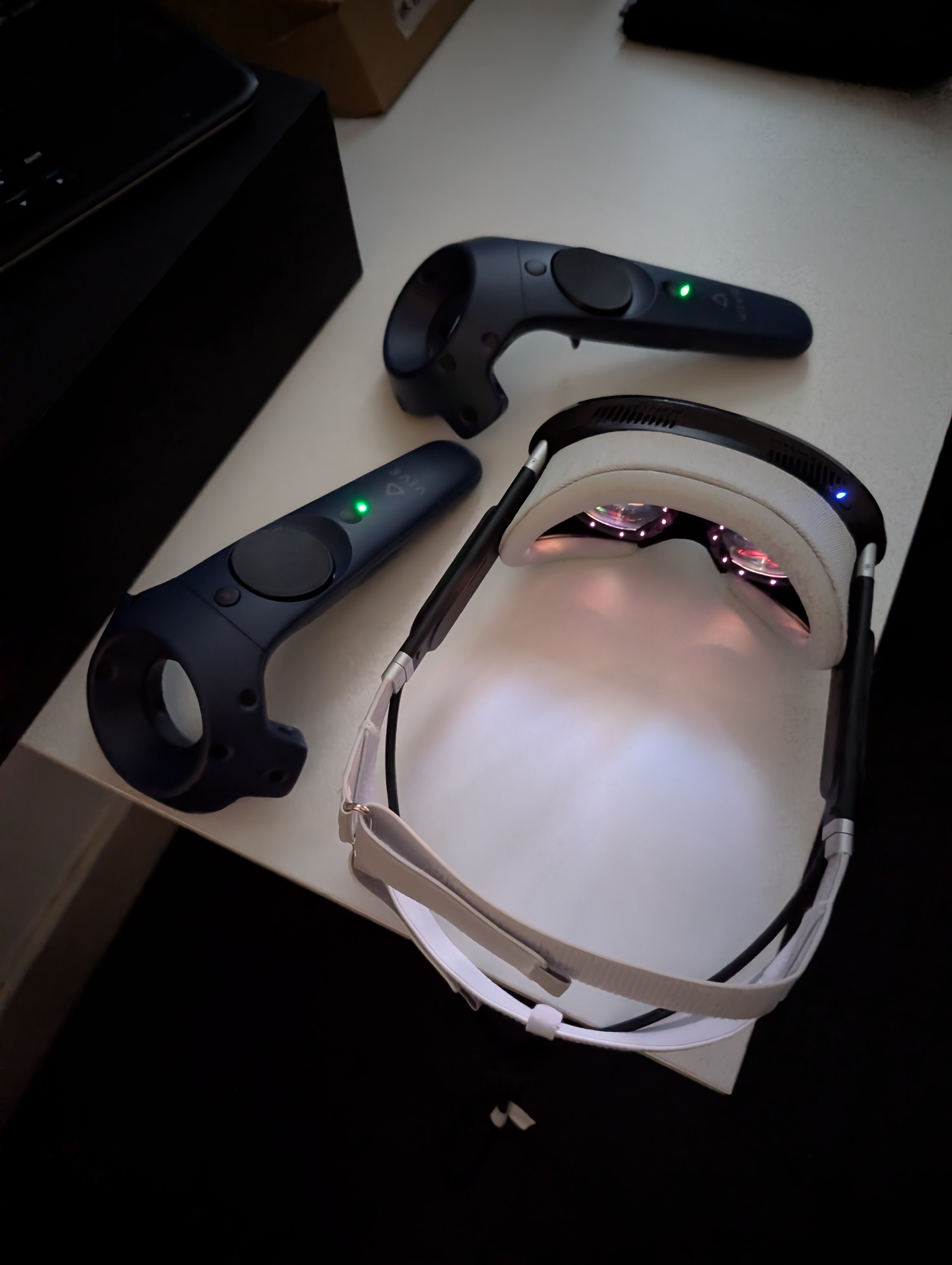
I am excited and curious for the possibility of more advanced tracking features from the Tobii eye trackers built into headsets like the Dream Air; advanced features translated to OSC data in Pimax Play, including eyelid width and pupil dilation, for social VR games.
I am under the assumption that Tobii licenses SDKs for developers or companies like Pimax to create these additional features, and that both these services may be a subscription-type with costs that eventually gets passed down to the consumer. What I’m hoping for is that payment would be a single transaction tied to a headset’s serial number as an end-user license for these advanced features provided by Pimax.
Please feel free to correct me where I am wrong in my statements and assumptions.
From my limited understanding there are two versions of the PCVR eye tracking
The Crystal original and Super QLED use a Tobii VR4 “hot mirror” to suit their aspherical lenses
whilst the Dream Air and Super micro-OLED use a new variant called Tobii XR5 for pancake lenses - reports are the hot mirror system is more accurate due to the camera placement but obviously not something that can be used for pancake lenses with their super compact design
According to redditor sebfox
“XR5 chip also does not support HTC’s Tobii SR model in BrokenEye, so you’d lose eyebrow emulation, (granular) eyelid tracking, squint/widen etc.”
Thank you for the info. I’ve heard about video feeds from the Tobii eye-tracking cameras in the Dream Air being processed and translated into additional OSC data for eyelids, eye openness, etc: for example, Jacobfov’s YouTube review video of the Dream Air. This unofficial method sounds similar to how SLAM tracking cameras monitor its surroundings. Perhaps this may be among future third-party implements mentioned in the Pimax Play Evo early access announcement? I can only hope and- with Pimax’s own experience in SLAM tracking- it’s a high hope.