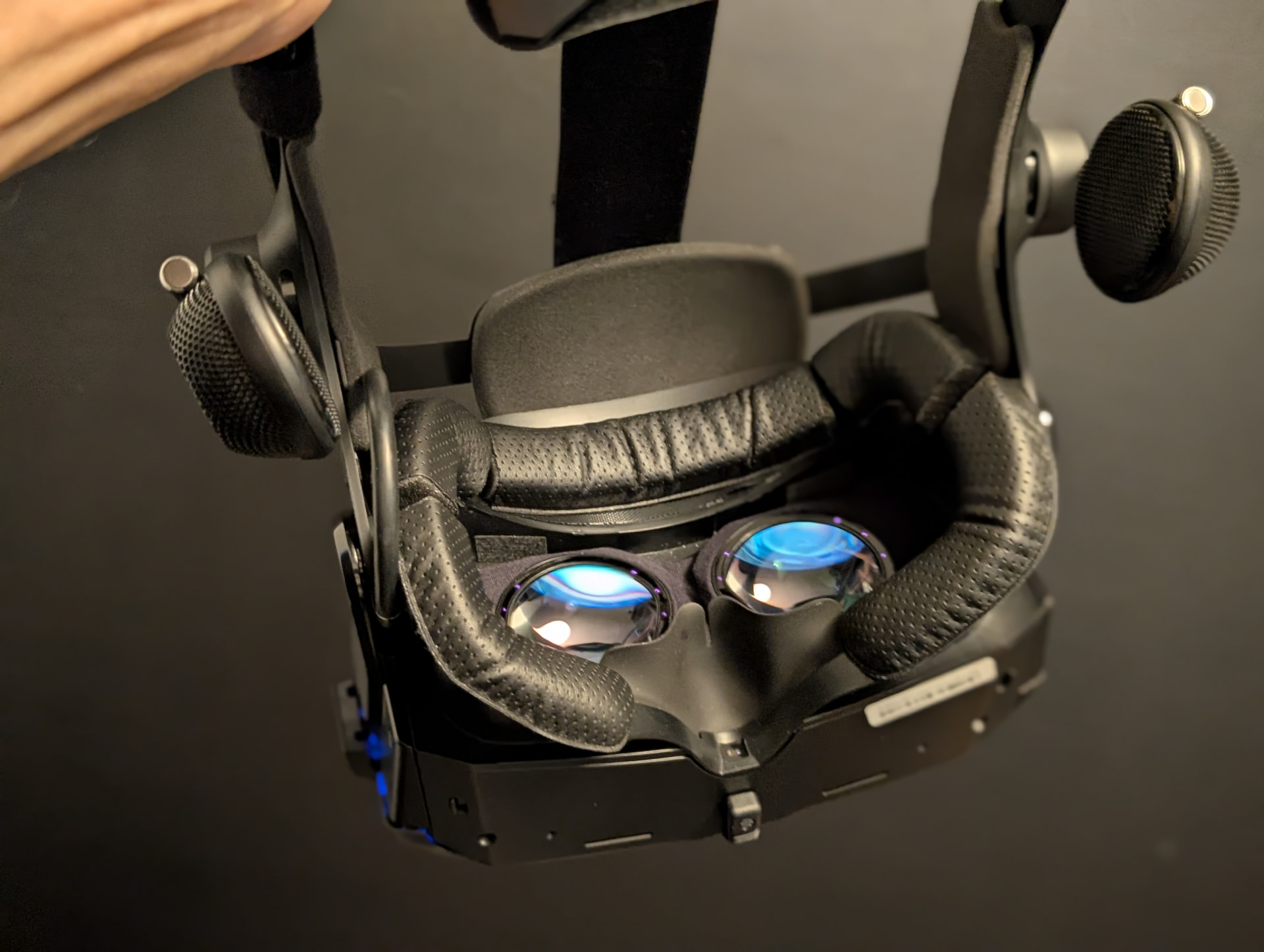
TL;DR: With a facial interface that brings the eyes closer to the lenses, Tobii eye tracking on the Crystal Super mostly stops working. The eye cameras still see the pupils perfectly; Tobii’s processing rejects the samples. I built a camera-based gaze estimate to prove it, and it works very well in MSFS 2024 foveated rendering. I’m asking Pimax and Tobii for a supported fix.
The setup. Crystal Super (micro-OLED) with a 3D-printed facial interface (Printables link) that brings my eyes closer to the lenses. The field of view and comfort are much better, and I’m not going back. But eye tracking barely works: calibration doesn’t see my eyes, and tracking drops or jitters. Background is in my earlier thread, where the working theory was that the cameras can’t see the pupils when the eyes are this close.
What the data shows. Using BrokenEye (thanks @XRC) I recorded the raw IR camera images alongside Tobii’s own output:
- The cameras see my pupils clearly. The pupils are sharp, the LED glints are visible, and a simple pupil detector finds the pupil in most frames.
- Tobii rejects most of them anyway. In the same recordings, gaze was marked valid on only about 1–15% of samples, often under 5%.
- So the hardware is fine and the images are usable. My guess is that Tobii’s 3D eye model places the eyes outside the eye box it was designed for, and discards those samples.
Proof it’s fixable. I built my own gaze estimate from the camera images: pupil detection in both cameras, a short calibration against known targets, and output to games through a standard OpenXR eye-gaze layer.
- About 1.5° median error against the calibration targets, out to ±30° horizontally and ±20° vertically.
- In MSFS 2024 with eye-tracked foveated rendering it was the best eye tracking I’ve had on this headset, far better than the stock tracking with this interface.
This is not just me. @Jetman_101 reported similar problems on a Dream Air until changing the facial interface. Anyone who customizes the interface to sit closer is likely to hit it, and the Dream Air may share the same geometry.
Requests to Pimax and Tobii (@PimaxQuorra):
- A setting to relax the eye-position validation for users whose eyes sit closer than the stock interface. The images are usable; the rejection is the problem.
- Official access to the eye camera images, or at least per-eye pupil position, through a supported API or license path. Right now the only way in is a closed-source third-party tool, which is a poor foundation.
- If Tobii licensing is the obstacle, would Pimax support or route a request for a personal developer license for this use?
I’m happy to share recordings, side-by-side images of frames Tobii rejected, and the accuracy numbers with your developers, and to test anything they send.
Others: if you use a custom or thinner facial interface and your eye tracking is flaky, please reply with your headset and interface. The more of us report it, the likelier this gets fixed.